
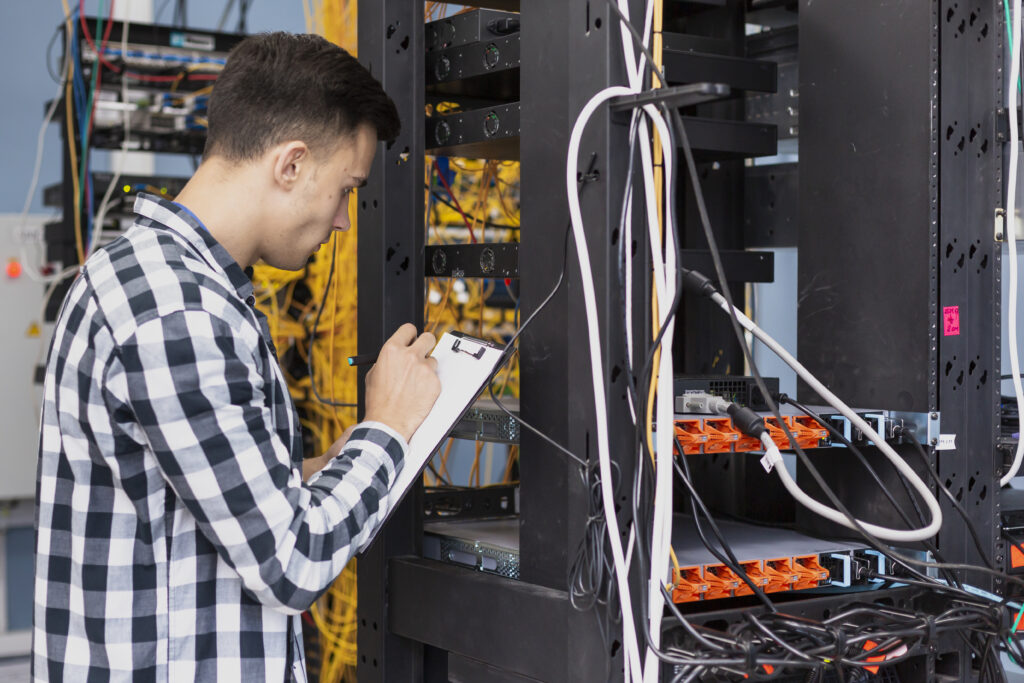
Security System Service and Repair
Everything here concerns equipment somebody else installed. The building already has cameras, readers, door hardware and a panel. What it lacks is documentation, administrative passwords, a maintenance history, or anyone who remembers why a device was wired that way. 24/7 Security takes over, diagnoses and maintains existing commercial security systems across the Central U.S.
The boundary of this page
If two working systems need to exchange data, that is security system integration. If an opening needs hardware specified from scratch, that is electronic door hardware. This page is about equipment already in the ground that is failing, aging out, or unaccounted for.
Symptoms, and what they usually turn out to be
A reported fault names a result, not a cause. Diagnosis works backward through power, path, then configuration.
- “We lost days of recorded video.” Typically a drive returning SMART errors, a retention window shorter than anyone believed, motion-only recording that never triggered, a switch over its PoE budget shedding cameras, or a clock offset hiding footage that exists.
- “That door works most of the time.” Mechanical before electrical: a closer out of adjustment, a strike no longer meeting the latch, a position magnet drifted out of range, a request-to-exit sensor with a shrinking field. Electrically, voltage drop on a long undersized run, or a standby battery that passes a voltage reading and fails under load.
- “The reader just died.” Wiegand gives no warning, being unsupervised and one-way. An OSDP run reports the loss at the controller, a practical reason to convert during a repair rather than replace in kind.
- “The panel stopped calling out.” The communication path changed underneath it: a retired copper line, a renumbered network segment, a firewall rule, or a cellular radio on a sunset network.
Taking over a system nobody documented
A takeover starts with a survey, not a repair: every opening and camera logged by manufacturer, model, firmware and condition; power supplies, batteries and circuits traced; the head-end located; and what is genuinely recording separated from what merely shows online.
Two obstacles recur. Administrative credentials are often gone, the previous integrator having changed them and left, so recovery can mean a factory reset with the configuration rebuilt from survey findings. Licensing is the other: licenses are sometimes held in a dealer account rather than the owner’s, and transferring them is a manufacturer conversation better started early than discovered at renewal.
Surveys also surface equipment nobody chose. Inherited camera fleets often include relabeled hardware from manufacturers named in Section 889 of the FY2019 NDAA, among them Hikvision and Dahua and their subsidiaries. That matters where a facility holds federal contracts, since 889(a)(1)(B) reaches entities that use such equipment, and where federal grant funds are spent, separately restricted under 2 CFR 200.216. For a building with no federal exposure it may not apply, but it belongs in the report. Replacement options are on our NDAA compliant cameras page.
Stabilize now, remediate on a plan
Emergency work and remediation are different jobs. Stabilization restores a secure condition today: an opening secured, a recorder brought back, a temporary reporting path in place. Remediation follows a written condition report separating what has failed, what is about to, what is past end of support, and what needs adjustment, so spending can be sequenced instead of chasing whichever device breaks next.
End of support is the honest limit on repair. Once firmware stops shipping, spare boards leave the channel, and the only software that speaks to a controller runs unpatched, repair costs more than replacement and leaves known vulnerabilities open. We would rather say so than sell another service call.
Regional wear patterns
Weather sets the maintenance calendar here. Midwest freeze-thaw cycles pump moisture into exterior conduit and housings, and water that entered in October becomes an intermittent fault in January, so enclosure seals, drip loops and conduit drainage get checked before the first hard freeze. Gulf humidity around Houston corrodes terminal blocks from the inside, showing up as resistance long before anything looks wrong. Storm season across the plains is hard on standby power: an outage exposes every battery already finished, and surges take out network gear that survived the outage.
Ask for a condition report
Send whatever you have, even a floor plan and a list of complaints. Call (888) 360-0035 or reach our Texas regional office at 3120 Southwest Freeway, Houston TX 77098. Our security system takeover and health audit page covers building a defensible baseline before anyone accepts an undocumented system.