
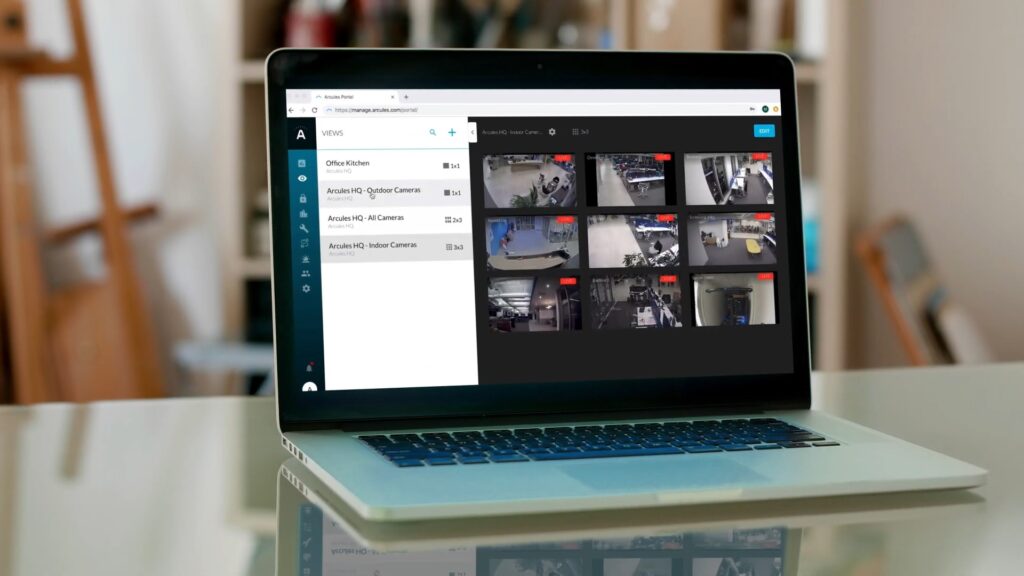
Arcules Cloud Video: Connection Architecture, Bandwidth and Retention
This page covers one narrow thing: the Arcules cloud video platform, how footage actually reaches the cloud, and what that decision costs in upload bandwidth and retention. Camera counts, lens choice and coverage layout are argued on video surveillance systems. The switching, fiber and WAN capacity a cloud deployment leans on sit under network services. What follows is the platform itself.
What Arcules is now, and why the name changed twice
Arcules was spun out of Milestone Systems in 2017 as a cloud-native video surveillance as a service platform. The two merged back together effective July 1, 2024. For several years Milestone also sold the identical platform under the name Milestone Kite; in January 2025 it retired the Kite name and renamed the entire VSaaS portfolio Milestone Arcules. Milestone is part of the Canon group. If you are holding a quote, a login or a renewal notice that still says Kite, it describes the same platform under a former name.
The on-premises counterpart is Milestone XProtect, on its own release track: XProtect 2026 R1 shipped with Device Pack 14.1, covering more than 16,300 verified devices. Sites are not forced to pick one permanently: a common shape is video recorded locally where a server is already justified, with the cloud carrying the smaller buildings and the people who need to see all of them at once.
Two ways video gets to the cloud
Every Arcules design turns on this choice, because it sets bandwidth, camera compatibility and what survives an outage.
- Edge gateway. A gateway appliance on the local network pulls streams from ONVIF cameras, buffers recording on site, and uploads to the cloud. Existing cameras generally keep working. Because the buffer is local, recording continues while the internet circuit is down and catches up afterward.
- Camera-to-cloud. Supported cameras connect directly with no appliance in the rack. Coverage includes Axis multi-sensor cameras and supported i-PRO models, and ONVIF Profile M and T cameras are handled in both cloud and gateway deployments.
The practical consequence is worth stating plainly: camera-to-cloud removes hardware but puts every stream on the internet circuit continuously. At a distribution building outside Indianapolis or a plant along the Illinois industrial corridor, usable upload is frequently a small fraction of the advertised download. We measure sustained upload before choosing, not after; where it will not carry the load, a gateway is the design that holds.
Retention, archive and the outage that decides it
Arcules supports long-term cloud archive, so footage can be held well past the working retention window and stay searchable without adding storage at the site. Retention is a per-camera argument rather than one site-wide number: a dock door tied to a claims process and a corridor camera nobody has ever pulled do not deserve the same window, and pricing them the same is how cloud video gets a reputation for being expensive.
Tornado-season utility interruption across the plains settles more of these designs than any feature comparison. A recorder alone in a closet loses precisely the window people want to review afterward. A gateway that has already offloaded, or a camera writing straight to a circuit that stays up, changes what still exists the next morning. That is an architecture question, not a camera question, which is why it belongs on this page.
Working with the platform
Our Arcules work runs to bandwidth measurement before an architecture is committed, gateway sizing, compatibility checks of existing cameras against the current device list, account and permission structure for operators watching Chicago, Milwaukee, St. Louis and Kansas City buildings from one browser, a WebSocket-based PTZ API for most ONVIF-connected cameras where automated workflows need it, commissioning against realistic scenarios, and version maintenance afterward. Continuous offsite viewing with someone actually watching is a separate service described under remote video monitoring. Where an inherited system is failing rather than absent, begin at service and repair. Where Arcules has to exchange events with door hardware or an alarm panel from another manufacturer, that is integration work.
Talk to us about an Arcules deployment
Tell us the site addresses, the circuits at each one, and what cameras are already installed. 24/7 Security serves the Central U.S. from headquarters at 6201 Fairview Rd, Charlotte NC 28210, with offices at 680 North Lake Shore Drive Suite 110, Chicago IL 60611 and 3120 Southwest Freeway, Houston TX 77098. Call (888) 360-0035. Other platforms we work with are listed under brands.
Arcules owner, administrator and buyer resources
These central technical guides support product and lifecycle planning while 24/7 Security coordinates regional survey, installation, commissioning, maintenance and repair.
Discuss Arcules installation, maintenance or service
Detailed guides are maintained by 360TechnologyGroup.com, the parent-company knowledge center.